Tudós
Csongor és TündeTudós, the play’s learned traveler, is a philosophical counterpoint to Csongor’s quest for happiness: he arrives in thought at a crossroads and later resurfaces, still absorbed in thought, in the desolate landscape of the final act. His speeches widen the play’s search beyond practical counsel, toward the limits of human capacity and the soul’s acts of thought, will, desire, and feeling. Yet the scenes supplied preserve him as a questioner rather than a figure who arrives at a definitive answer.
Identity and Introduction
The cast identifies Tudós among the travelers and defines him by his learning. His stage presence reinforces that identity: he is introduced not in the midst of some practical task but as a man who comes onstage reflecting, and later as one deeply immersed in thought. These directions make contemplation his most consistent dramatic attribute.
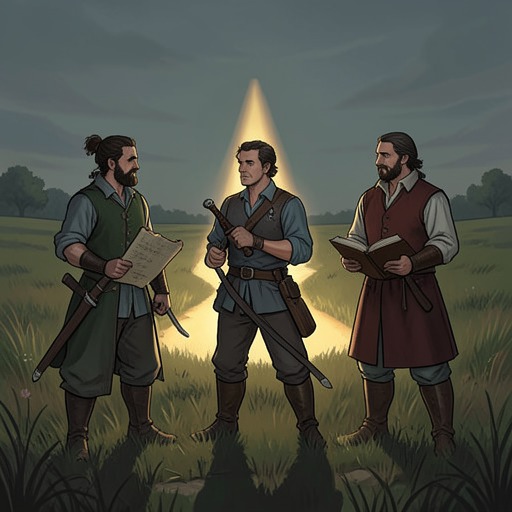
His first appearance comes at the three-way crossroads, a setting that gathers travelers and competing paths. Csongor has turned to the travelers in hope of advice that might lead him to a dwelling of happiness. Tudós’s entrance in this setting places intellectual reflection among the possible responses to Csongor’s search, while leaving open whether learning can provide the promised destination.
Counsel at the Crossroads
The crossroads scene brings Tudós into the dramatic company of Csongor and Balga. The play does not make the mere fact of his learning a guarantee of insight: his entrance is marked as reflective, and his ensuing speech opens onto difficult questions rather than a simple practical solution. His presence therefore complicates the expectation that a wise traveler can direct Csongor to happiness.
In his philosophical meditation, Tudós considers the soul as the subject that thinks and wills, desires and imagines, grieves and rejoices. The sequence gives the soul a wide range of mental and emotional activity, moving between intention and imagination, sorrow and joy. Instead of reducing human life to a single appetite or one route toward fulfilment, his formulation emphasizes the many operations through which a person experiences and interprets the world.
The surrounding speech also reflects on human beings as vulnerable to their own self-interest. That emphasis gives the meditation an ethical edge: reflective intelligence does not automatically free people from self-concern. The crossroads thus carries an irony. It is where Csongor seeks guidance toward happiness, but the learned traveler’s thought draws attention to the inward limits that may complicate any such search.
Return in the Final Act
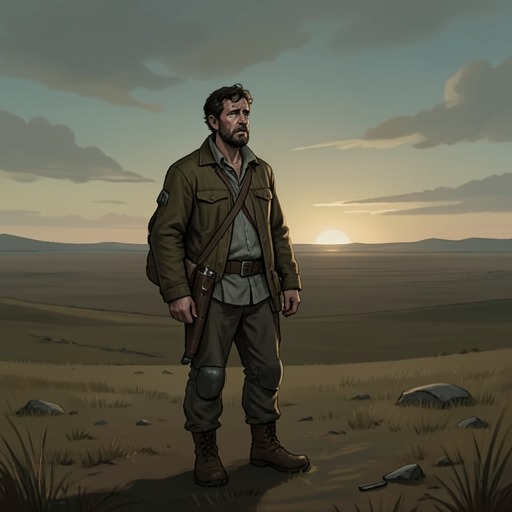
Tudós appears again in the fifth act, in a desolate landscape where Tünde and Ilma have also entered. The stage direction once more identifies him through absorption in thought. His return links the earlier crossroads meditation to the play’s final movement without suggesting that his philosophical inquiries have been settled in the interval.
In this later scene, his speech takes up human incapacity and immortality. Those concerns extend the earlier attention to the soul: reflection now reaches beyond the changing experiences of grief and joy toward the prospect of life’s limits and what might lie beyond them. The contrast between a desolate setting and the abstract scale of his subject matter makes his appearance feel like a renewed inquiry, not a report of discoveries or a change in fortune.
Narrative Role and Limits of the Evidence
Tudós functions as one of the play’s traveling interlocutors, bringing philosophical language into a quest otherwise organized around movement, encounters, and the search for happiness. His two marked appearances frame that role across the journey: first at the three-way crossroads, then in the desolate landscape of the fifth act. The repeated stage image of the absorbed thinker binds the episodes together, while the subjects of his speeches extend from the soul’s activity and human self-interest to incapacity and immortality.
The supplied scenes do not establish a personal backstory, a separate objective, or a final resolution for Tudós. Nor do they show that he supplies the answer Csongor seeks. His significance lies instead in the questions he brings into the journey: whether human thought and desire can overcome self-concern, and how finite capacity relates to the idea of immortality. The play gives those questions a voice, but the evidence available here leaves Tudós himself in the posture with which he is introduced—still thinking.